Showing posts with label Prior. Show all posts

Tuesday, 12 June 2018

The greatest ever wicket keeping batsman.

The first article that I wrote that garnered any attention was a look at Matt Prior's career as a wicket-keeper batsman, and to see how he stacked up against some of the greats: Gilchrist, Flower and Ames. It had about 200 reads, until Jarrod Kimber tweeted out a link to it, and then it had about 1000, doubling the total number of reads that my blog had had up until that point. Then there was a rain break in the England vs India test, and one of the Cricinfo commentators decided to link to the article with "here's something to look at while you wait for the rain to clear." I was swamped. About 24000 people read that article in the next 4 hours, and my little project blog became something that people started to read.

I also included a brief comparison with MS Dhoni, which got me a couple of death threats, for daring to suggest that Prior was better than Dhoni. (My favourite was "I'm going to come to England and burn your house down, you biased English." - not particularly concerning at the time, as I lived on the opposite side of the world from England).

I'm going to attempt to play with fire again, and re-look at the question.

Over the past 6 months, I've given up my job, and gone back to university to study statistics. This post is in part me attempting to use some of the tools that I've learned in that process.

One thing that comes up when discussing this, is how difficult it is to bat and keep, and if it's easier to bat with the tail, or with at the top of the order.

To try to answer those questions, I took some information for a few keepers, and had a go at running some models on them. The list of keepers that I've looked at is: Adam Gilchrist, Kumar Sangakkara, Andy Flower, Matt Prior, Brendon McCullum, Mahendra Singh Dhoni, Mushfiqur Rahim, Alec Stewart and BJ Watling. Initially, I also looked at Clyde Walcott and Les Ames, but it was difficult to get some of the information to build the models for them, so I've left them out. I'm only looking at batting. This is comparing the batting of players who kept wickets.

The variables that I looked at were as follows:
1. Average of partnerships when they came to the wicket. For example if a player came to the crease at 20/4, this was 5, if they came to the wicket at 380/2 it was 190. For opening batsmen I used 21, as this is the median opening partnership, so it is a reasonable expectation of how difficult it is to bat.
2. How many balls have passed. If the player comes to the wicket in the 51st over, it's likely to be different conditions to coming to the wicket in the 3rd over.
3. Are they the designated keeper or not. For some players, being the designated keeper hurts their batting, but for others it has the opposite effect.

I then split the data into two randomly, created the most parsimonious model that I could with half of one particular batsman's data, and then tested it on the other half of the data. I repeated this 100 times, then took the average coefficients from the 10 models that tested the best.

There are possibly better options for how to do this, but it seemed to return reasonably sensible results.

The next thing that I did was to apply those models to a number of different scenarios, some as a keeper, and some as a batsman.

That resulted in the following graph:


The answer to the question, based on these models, is quite comprehensively Andy Flower. If you're wanting to select another one, as a pure batsman Sangakkara is your man. If you want someone to bat in a crisis, then Gilchrist is the second best option, but to grind the opposition into the dust, after, Flower, you would want BJ Watling.

I quite like the idea of thinking about players based on situations, rather than overall averages. There is certainly more options that I could look at to build the model, including controlling for opposition and location. But for now this is an interesting look at a difficult problem.

Wednesday, 27 March 2013

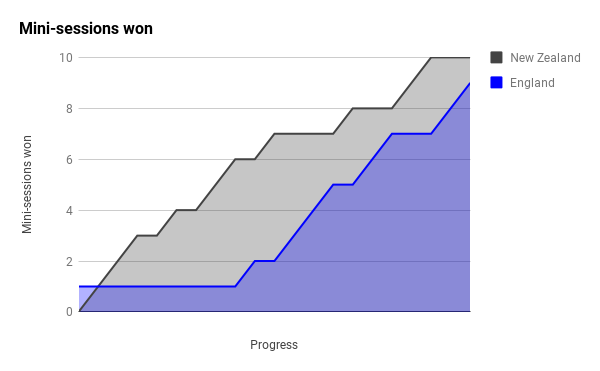
Mini-session analysis, 3rd test, New Zealand England, Eden Park, 2012/3

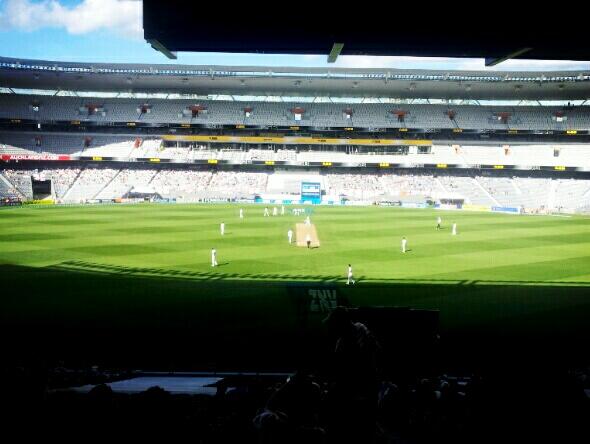
Here is the final mini-session analysis for the third test between New Zealand and England at Eden Park, Auckland, New Zealand

A mini-session is (normally) half a session, either between the start of the session and the drinks break or the drinks break and the end of the session. Occasionally a long session will have 3 mini-sessions where it will be broken up with 2 drinks breaks.

Mini-SessionScoreWinner
1-1aNew Zealand 31/0 off 15draw
1-1bNew Zealand 48/1 off 13New Zealand
1-2aNew Zealand 48/0 off 15New Zealand
1-2bNew Zealand 46/0 off 16New Zealand
1-3aNew Zealand 36/0 off 13.4New Zealand
1-3bNew Zealand 41/0 off 17.2New Zealand
2-1aNew Zealand 24/1 off 14England
2-1bNew Zealand 38/2 off 14England
2-2aNew Zealand 53/1 off 10.4New Zealand
2-2bNew Zealand 49/1 off 17.2draw
2-3aNew Zealand 29/4 off 6New Zealand
2-3bEngland 50/2 off 25New Zealand
3-1aEngland 22/3 off 11.5New Zealand
3-1bEngland 20/0 off 17.1New Zealand
3-2aEngland 39/0 off 15England
3-2bEngland 45/1 off 14draw
3-3aEngland 28/4 off 6.2New Zealand
3-3bNew Zealand 20/3 off 11England
3-3cNew Zealand 15/0 off 12England
4-1aNew Zealand 47/1 off 12.3New Zealand
4-1bNew Zealand 94/0 off 13.3New Zealand
4-2aNew Zealand 65/2 off 8.2New Zealand
4-2bEngland 45/1 off 16New Zealand
4-3aEngland 32/1 off 20New Zealand
4-3bEngland 13/2 off 16.1New Zealand
5-1aEngland 37/0 off 16.5England
5-1bEngland 31/1 off 14New Zealand
5-2aEngland 41/1 off 13England
5-2bEngland 38/1 off 14.3draw
5-3aEngland 38/0 off 17.3England
5-3bEngland 40/2 off 15New Zealand

Final update, click here
The match is drawn, but New Zealand win the mini-session count 19 - 8

First drinks, Day 1: The mini-session count is tied up, 0-0

A steady, but unspectacular start from New Zealand after being inserted. I do wonder if McCullum was actually foxing about wanting to bowl first.

Lunch, Day 1: New Zealand lead the mini-session count 1-0

A good start by Rutherford and Fulton was soured by a loss of concentration by Rutherford at the end of the session. Still New Zealand are in a good position.

Final drinks, Day 1: New Zealand lead the mini-session count 4-0

England have almost seemed to give up on trying to get a wicket, and are hoping that these two batsmen will get themselves out. Their lines and lengths have not been what should be expected of a test attack. Only Stuart Broad has had the batsmen under any sort of pressure.

Stumps, Day 1: New Zealand lead the mini-session count 5-0

This pitch is not as easy to bat on as these two are making it look. I was watching the majority of that hour from square of the wicket, and the bounce was variable.

First drinks, Day 2: New Zealand lead the mini-session count 5-1

England finally found a way through this partnership. It's the third largest partnership against England in New Zealand, and the third largest 2nd wicket partnership at Eden Park.

Final drinks, Day 2: New Zealand lead the mini-session count 7-2

Southee batting at 8 doesn't make much sense when a team is trying to save a match. In a situation like this, however, it's a great move. He has taken the game to England, and New Zealand now have a respectable first innings score, and much faster than it was looking like.

Stumps, Day 2: New Zealand lead the mini-session count 8-2

Trent Boult picked up two wickets to make it well and truely New Zealand's day. England will need to bat well tomorrow.

First drinks, Day 3: New Zealand lead the mini-session count 9-2

Boult and Southee were in Sri Lanka form this morning. They looked unstopable. England are in serious trouble now.

Lunch, Day 3: New Zealand lead the mini-session count 10-2

20 runs in the hour. While Wagner and Martin didn't make the breakthrough, they certainly kept things tight.

Tea, Day 3: New Zealand lead the mini-session count 10-3

England were looking very good there until Prior made a bad call and played a shot that he will regret. New Zealand now have one end open with the new ball.

Change of innings, Day 3: New Zealand lead the mini-session count 11-3

Trent Boult and Tim Southee finished off the tail. Boult was probably unlucky that Southee dismissed Root at the end, as he would have probably backed himself to pick up Monty fairly quickly and turn 6 into 7. McCullum chose not to enforce the follow on, which seems the right decision to me. It means he gets to chose the heavy roller twice, he gets to give his bowlers a rest and he isn't going to have to bat last on a potentially deteriorating pitch. I'd expect this pitch to take some real turn on the last day and a half.

Final drinks, Day 3: New Zealand lead the mini-session count 11-4

What a disastrous start by New Zealand. Anderson and Borad have combined to leave New Zealand in tatters. England have a serious sniff now. Perhaps McCullum made the wrong call.

Stumps, Day 3: New Zealand lead the mini-session count 11-5

New Zealand see out the day, but what was their day suddenly took a dive at the end. Still New Zealand are in a stronger place at the end of the day than at the start of it. 11 wickets fell again today. This is starting to look very interesting.

First drinks, Day 4: New Zealand lead the mini-session count 12-5

Fulton and Brownlie made some steady progress in the morning. They have gone close to getting New Zealand to safety. Probably New Zealand want about another 80 runs before a lunchtime declaration.

Lunch, Day 4: New Zealand lead the mini-session count 13-5

With Fulton into the 90s, a lunchtime declaration is now probably off the cards. Perhaps once he gets to 100 it will be time to head back?

Middle drinks, Day 4: New Zealand lead the mini-session count 14-5

McCullum took a lot longer to declare than I was expecting, but it might have been due to the runs being so easy to score this morning. The fear that one English batsman would "do an Astle" is probably too strong. Cook is likely to be criticized for his tactics in that hour, but they were sensible, given the situation.

Tea, Day 4: New Zealand lead the mini-session count 15-5

An early breakthrough, and England are looking shaky now. They need a big partnership.

Stumps, Day 4: New Zealand lead the mini-session count 17-5

The thought that Kane Williamson would have provided the vital breakthroughs at the end of the day was quite surprising, but he certainly bowled well. Cook looked furious at himself, while Finn looked like a wicket waiting to happen.

First drinks, Day 5: New Zealand lead the mini-session count 17-6

Solid batting from Root and Bell. New Zealand really need a wicket before lunch, so they can bowl at new batsmen with the new ball.

Lunch, Day 5: New Zealand lead the mini-session count 18-6

The wicket came with the first delivery of the new ball. And there could have been more. First Bairstow survived an lbw shout that turned out to be very close, and then both batsmen were dropped off Boult's second over with the new ball. The big question now is if they will make the most of their lives.

Middle drinks, Day 5: New Zealand lead the mini-session count 18-7

England make steady progress through the day, but New Zealand chip out another one. Prior is living dangerously. His 20 has come off 24 balls, and has included a couple of top edges, some playing and missing, and two very close umpiring calls.

Tea, Day 5: New Zealand lead the mini-session count 18-7

It had started to look like these two were going to see it out, but then Wagner removed Southee to complete the session, and now the impetus is back with New Zealand.

Final drinks, Day 5: New Zealand lead the mini-session count 18-8

Superb from Prior and Broad. This is a big innings for Broad in particular. He has been talked up as a batsman for a long time, here is a chance for him to deliver.

Stumps, Day 5: The match is drawn, but New Zealand take the mini-session count 19-8

A thrilling end, even if somewhat of a let down for the home-town supporters. There was an older gentleman, probably in his late 70's or early 80's sitting a couple of seats along from me. When Anderson was dismissed he was up out of his chair, waving his hand above his head and shouting. No sport creates emotion like a test match. In the end New Zealand didn't do quite enough to win the match. They will rue the dropped catches, as well as the ball hitting Prior's stumps, but not knocking the bails off.

England will probably be more relieved than proud of their effort. Prior stood out like a sore thumb amongst his compatriots, while New Zealand had a number of candidates for an internal man of the match. It's a match that will live on in the memories of everyone who was fortunate enough to have watched it.

Friday, 30 December 2011

Test team of the year

I put together an ODI team of the year, and I'm going to use a similar method for test team of the year.

The first thing that needs to be decided on is the balance of the team. Often the successful teams play with 4 bowlers and one batsman who can contribute with the ball. (There has only been one game this year where a team has won with only using 4 bowlers)

This time rather than using matches at the World cup as a premium, I'm looking at away matches as the premium. This year we have seen some very good performances by home teams, and only a few by away teams, so there needs to be a bonus for teams performing away from home. (For the purpose of this I don't consider games in UAE as away games for either team)

Openers, Alastair Cook & Tino Mawayo

This was selected from batsmen who had played at least 6 innings as openers.

The selection was fairly straight-forward

PlayerMatchesRunsActual AveragePoints
AN Cook (Eng)892784.2784.31
TMK Mawoyo (Zim)331062.0059.17
Taufeeq Umar (Pak)1083146.1646.55
DA Warner (Aus)319548.7543.84
Mohammad Hafeez (Pak)1064740.4336.41
V Sibanda (Zim)327245.3336.40
GC Smith (SA)532240.2536.20

In reality Tino Mawoyo's first class record suggest it is unlikely that he will turn out to be a world class opener, but he has produced world class numbers this year (including carrying his bat for a particularly memorable 453 ball epic 163* against Pakistan). And Zimbabwe has produced some outstanding batsmen in their short test history.

Number 3 Rahul Dravid

This was not so straight forward, as the runs below were not just scored at number 3. Dravid did better when he opened the batting, and Amla did worse the one innings that he didn't bat at number 3. Sangakkara scored the most runs, but didn't manage any not out's so his average suffered accordingly.

PlayerMatchesRunsActual AveragePoints
R Dravid (India)12114557.2559.05
KA Edwards (WI)659554.0953.12
SE Marsh (Aus)428741.0048.67
Azhar Ali (Pak)1073245.7545.14
KC Sangakkara (SL)11103449.2343.93
HM Amla (SA)542347.0042.27
IJL Trott (Eng)636540.5536.47

Numbers 4 & 5 Younis Khan & Ian Bell

Ian Bell has batted at 6 for this year, but he has been a specialist batsman, rather than an all-rounder.

PlayerMatchesRunsActual AveragePoints
IR Bell (Eng)8950118.75110.24
Younis Khan (Pak)876585.0083.93
Misbah-ul-Haq (Pak)1076569.5475.15
KP Pietersen (Eng)873173.1065.07
DG Brownlie (NZ)326853.6060.76
S Chanderpaul (WI)864653.8354.21
DM Bravo (WI)1094949.9453.91
BRM Taylor (Zim)335871.6050.44
SR Tendulkar (India)975647.2549.62
MEK Hussey (Aus)968042.5048.18
TT Samaraweera (SL)750141.7546.82
Shakib Al Hasan (Ban)545150.1146.54
JH Kallis (SA)535951.2846.12

All rounder Mike Hussey

This was a surprise. I was expecting Shakib, Watson, Vettori or Kallis to come out on top here. Hussey was hardly a front-line bowler, but we are only looking for someone who can contribute, and of the players that do that he has been the most effective this year. Kallis has not exactly had a vintage year with the ball, bowling 61 overs for 232 runs. Watson however has been outstanding with the ball, but surprisingly poor with the bat, especially since I thought I remembered him batting really well.

PlayerBattingBowlingDifference
MEK Hussey (Aus) 48.1817.9730.21
Shakib Al Hasan (Ban) 46.5430.6615.88
Mohammad Hafeez (Pak) 36.4122.6613.75
DL Vettori (NZ) 40.2327.6812.55
AD Mathews (SL) 40.5230.589.94
R Ashwin (India) 34.5927.257.34
SR Watson (Aus) 23.8217.146.68
Azhar Ali (Pak) 45.1438.926.22
DJG Sammy (WI) 18.1930.13-11.94
TM Dilshan (SL) 35.2153.45-18.24
MN Samuels (WI) 32.5154.06-21.55
IJL Trott (Eng) 36.47110.09-73.62
JH Kallis (SA) 46.12257.98-211.86

Wicketkeeper Matt Prior

This was the easiest decision of all.

Matt Prior is so far above the rest of the keepers in terms of batting that he really selects himself. His numbers don't indicate that he is the best keeper, but given that he concedes about 5 byes per innings, but his adjusted average is about 25 runs more than the next best with the bat, he can't be overlooked.

Here is the batting stats for everyone who averaged 35 or higher:

PlayerMatchesRunsActual AveragePoints
MJ Prior (Eng)851964.8764.90
T Taibu (Zim)326744.5039.17
Adnan Akmal (Pak)821135.1636.54
Mushfiqur Rahim (Ban)534037.7735.07

And their byes stats:

NameByesDeliveriesByes/100 overs
Adnan Akmal (Pak)2685591.82
T Taibu (Zim)1525813.49
Mushfiqur Rahim (Ban)3447414.30
MJ Prior (Eng)6580964.82

The intangible is dropped catches. It is more work than I'm prepared to do to go back and count the number of catches dropped. If Adnan or Taibu had not dropped any catches, and Prior dropped 1 per game, then there would be a difficult decision, but given that we don't have any data we have to proceed on the understanding that there is no significant difference between them.

Bowlers James Pattinson, Shane Watson, Doug Bracewell and Saeed Ajmal

Here I decided that a bowler had to have bowled 90 overs. I got this number as it was roughly the lower quartile of bowlers who had bowled in 5 innings. This was better than just using 5 innings, as measuring in overs allows more consistency (someone who bowls 2 overs in each of 5 innings just giving a rest to the other bowlers and picks up 3 wickets for 55 runs because the batsmen are slogging him would end up with a very good average despite not being a front-line bowler - for a less extreme version of this see Mike Hussey) Unfortunately Vernon Philander just missed out on this.

I also needed to have at least 2 quick bowlers and at least 1 spinner. The final position comes down to performance (although in reality it would probably come down to the conditions). As a result I have picked Saeed Ajmal, as the best spinner.

NameMatchesOversWicketsActual AverageWeighted Average
JL Pattinson (Aus)398.52015.2016.90
SR Watson (Aus)6113.51419.0717.14
DAJ Bracewell (NZ)31011619.2517.39
TT Bresnan (Eng)4139.32119.0920.95
Z Khan (India)3114.21323.1521.46
DW Steyn (SA)5178.42819.5721.76
Saeed Ajmal (Pak)84875023.8621.97
Mohammad Hafeez (Pak)101671525.9322.66
Aizaz Cheema (Pak)4146.41924.7823.38
U Yadav (India)396.31622.9323.42
P Kumar (India)6268.32725.8123.92
Abdur Rehman (Pak)84123626.2724.39
SCJ Broad (Eng)7270.23322.3024.80
PP Ojha (India)3177.22022.5025.02
Umar Gul (Pak)8287.53425.6725.09
JM Anderson (Eng)7296.23524.8525.57
R Rampaul (WI)8283.13125.0326.20
R Ashwin (India)42212624.8027.25
DL Vettori (NZ)4228.11627.1227.68
CS Martin (NZ)51922029.4527.94
NM Lyon (Aus)8198.42327.4728.64
CT Tremlett (Eng)5207.42327.1729.71
HMRKB Herath (SL)10470.14129.0729.92

Most of the players selected have not played much cricket, and just scrape in on overs bowled. If we extended that to 150 overs required the line up would be Dale Steyn, Praveen Kumar, Saeed Ajmal and Mohammad Hafeez.

The team (in batting order)

Alastair Cook
Tino Mawoyo
Rahul Dravid
Younis Khan
Michael Hussey
Ian Bell
Matt Prior
Shane Watson
Doug Bracewell
James Pattinson
Saeed Ajmal

12th man Mohammad Hafeez

Surprisingly there are no South Africans or Sri Lankans in the team. There are also no West Indians or Bangladeshis either.

That's my stats based team. What is your team?

Friday, 29 July 2011

Quick preview 2nd Test Eng vs Ind

Just a couple of things that I notices, and a bit of quick tips for the gamblers out there.

Trent Bridge has been cruel on openers over the last few years, but it has produced lots of runs for batsmen batting at number 7.

Dhoni also has a great record in the second test of a series.

I'd look at Dhoni to score more than 40 here. I'd also look at Pietersen to do badly here, as he normally follows up a big score with a number of low ones.

I'd look closely at Prior to be the top scorer for England, and also for Dravid to be the top scorer for India, as he has good technique, and tends to shine on difficult pitches.

Wednesday, 27 July 2011

Does keeping influence batting?

My post a month and a bit ago about Matt Prior has generated a significant amount of interest, including one specific comment that I would like to address.

Unfortunately the poster was anonymous, but they recommended Sangakkara as the greatest wicket-keeper batsman, pointing out that he batted at number 3 and often had to come into bat in the first 5 overs. It made me wonder just how hard batting after keeping was. So I had a look at some stats...

I found 5 players who have played at least 10 innings as keeper and non-keeper: Here are their averages:

NameInngs keepingAvg keepingInngs not keepingAvg not keeping
AJ Stewart14534.929046.70
KC Sangakkara8140.488172.75
AC Parore10926.941922.70
A Flower10053.701235.45
BB McCullum8534.771255.18


The last three in the list probably don't give us enough information to be able to say too much, although both Flower and Parore are curious in that they averaged better when keeping than not keeping. In Parore's case it might have been because he usually batted at 7 or 8 when keeping, and at 3 when not keeping. It also might have been that he was less confident of his place in the side when Lee Germon was the captain, and so did not bat with the same confidence. Another possible explanation was that the matches he didn't keep in were the ones where Glenn Turner was in charge of the team, and his style of coaching might not have suited Parore.

Likewise most of the matches where Flower didn't keep were at the end of his career where there was increasing political tension in Zimbabwe. This was obviously impacting him - and led to the famous black armband incident. (As an aside - Henry Olonga's autobiography, which mentions this incident "Blood Sweat and Treason" is well worth reading.) But he also might have batted better when he got a chance to have a look at a pitch after keeping.

But the overall theme of the statistics is that batsmen bat better when they are not keeping. Sangakkara is particularly astounding. His average of over 70 is impressive, especially as he is such a fluid batsman that all 72.75 of them will have probably flowed in an aesthetically pleasing manner off his bat.

It also goes to underline how fortunate we are to be living in a time with so many great wicket-keeper batsmen. All of Prior, Dhoni, Gilchrist, Flower, McCullum, Sangakkara... have been producing such remarkable numbers that they have transformed the entire position.

Saturday, 4 June 2011

Greatest wicketkeeper-batsman?

I noticed that Matt Prior was unbeaten on 73 off 83 overnight in the test match. That leaves him with an average this year of 191.

I've commented in previous posts about how good his activity rate is, and also how good he is at converting a start. But now I wonder how he compares among the greatest wicket-keeper batsmen.

The stats are quite interesting. First here is the overall averages for the last 5 years:

Namematchesinningsrunsaveragestrike rate100's50's
MJ Prior (Eng) 4262222144.4264.58417
MS Dhoni (India) 4467240340.7257.37317
BJ Haddin (Aus) 3254190539.6858.7438
BB McCullum (NZ) 2850169936.1461.6439
HAPW Jayawardene (SL) 3344127833.6350.7133
MV Boucher (SA) 4564191633.0350.24113
Kamran Akmal (Pak) 3053149630.5363.17210
TR Ambrose (Eng) 111644729.8046.4113
Mushfiqur Rahim (Ban) 2141111629.3644.3916
D Ramdin (WI) 3357113622.7249.6216


He sits at the top of this table, with a better average, strike rate and 50-100 conversion rate than Dhoni. (note this is every player who played 15 or more innings as keeper - hence the exclusion of Sangakkara and AB de Villiers as they played mostly as batsmen, and the low numbers for McCullum, who has scored most of his runs as a batsman also)

So how does he compare overall:
Nameyearsmatchesinningsrunsaverage100's50's
A Flower (Zim) 1992-2002 55100440453.701223
AC Gilchrist (Aus) 1999-2008 96137557047.601726
MJ Prior (Eng) 2007-2011 4262222144.42417
LEG Ames (Eng) 1929-1939 4467238743.4087
KC Sangakkara (SL) 2000-2008 4881311740.48711
CL Walcott (WI) 1948-1951 152488840.3633
MS Dhoni (India) 2005-2011 5482292540.06420
DT Lindsay (SA) 1964-1970 1526100040.0034
BJ Haddin (Aus) 2008-2011 3254190539.6838
AJ Stewart (Eng) 1991-2003 82145454034.92623
BB McCullum (NZ) 2004-2010 5185278234.77515


He is a long way behind Flower, who really was in a class of his own, but is fairly close to Gilchrist's average. But sometimes it is a mistake to assume that where somebody is in their career is where they will end up. One thing that is remarkable about Prior is his consistency. Every single year he has played test cricket he has managed to average 40 or higher. This is quite an achievement. To take in account the development of players, I looked at the averages of a number of the great wicket-keeper batsmen to see how well they were going at the point in their careers that Prior is at now.

Here is a list of the great wicket keeper batsmen after 62 innings:
Namematchesinningsrunsaveragestrikerate100's50's
AC Gilchrist (Aus)4462294058.8082.65816
MJ Prior (Eng)4262222144.4264.58417
A Flower (Zim)3362214541.2541.78512
KC Sangakkara (SL)3862236540.7752.3467
MS Dhoni (Ind)4062217640.2962.24317
LEG Ames (Eng)4162200637.8475

*note Les Ames did not have the number of deliveries recorded, but he scored at about 50 runs per hour, during a time when they bowled about 20 overs per hour, so rough strike rate of 85 - similar to Gilchrist.

Two things stand out from this list. One is how high Gilchrist's average is, and the second is how low Flower's average is. It shows quite clearly the difference between them in the end of their careers. Prior sits quite neatly between them, suggesting that he has the potential to join those two players that totally redefined the role of a wicket-keeper batsman.

The bottom name on that list is an interesting one. Les Ames played in a different era, when keepers often came in at number 11, and were not expected to bat well. Wisden wrote at the time of his death that he "was without a doubt the greatest wicketkeeper-batsman the game has so far produced..." He scored runs with an incredible consistency, seventeen times scoring more than 1000 runs in a first class season. If Prior can have anything like Ames' consistency and durability (he played 593 first class matches over 25 years) then his final career record could be something to behold.

How he goes in comparison to Dhoni will also be interesting to watch. Since Dhoni took over the captaincy his average has been constantly rising. Most players don't find captaincy to be helpful with their figures, but here are the averages for players who were both captain and keeper in the match:

Namematchesinningsrunsaverage100's50's
MS Dhoni (India) 2434150350.10311
A Flower (Zim) 1630123249.2837
T Taibu (Zim) 102067437.4415
AJ Stewart (Eng) 122478137.1913


To be ahead of Andy Flower in any list is quite an achievement, and it will be interesting to see if Dhoni manages to hold his spot there.